Building on Professional Experience – Juho Golnick’s Story of Studying Theatre and Live Event Technology
Juho Golnick’s path to becoming a theatre technology professional was not entirely straightforward. As a young theatre enthusiast, he originally dreamed of becoming an actor. When he was not accepted into the Theatre Academy, he applied for and began studying drama instruction instead.
During his studies, his interests gradually shifted from acting to directing, and he completed his artistic thesis as a dramaturgical work. At the same time, he noticed a recurring pattern in student productions: whenever someone with lighting or sound expertise was needed, fellow students often turned to him to design the lighting for their performances. Eventually, he found his career in theatre technology.
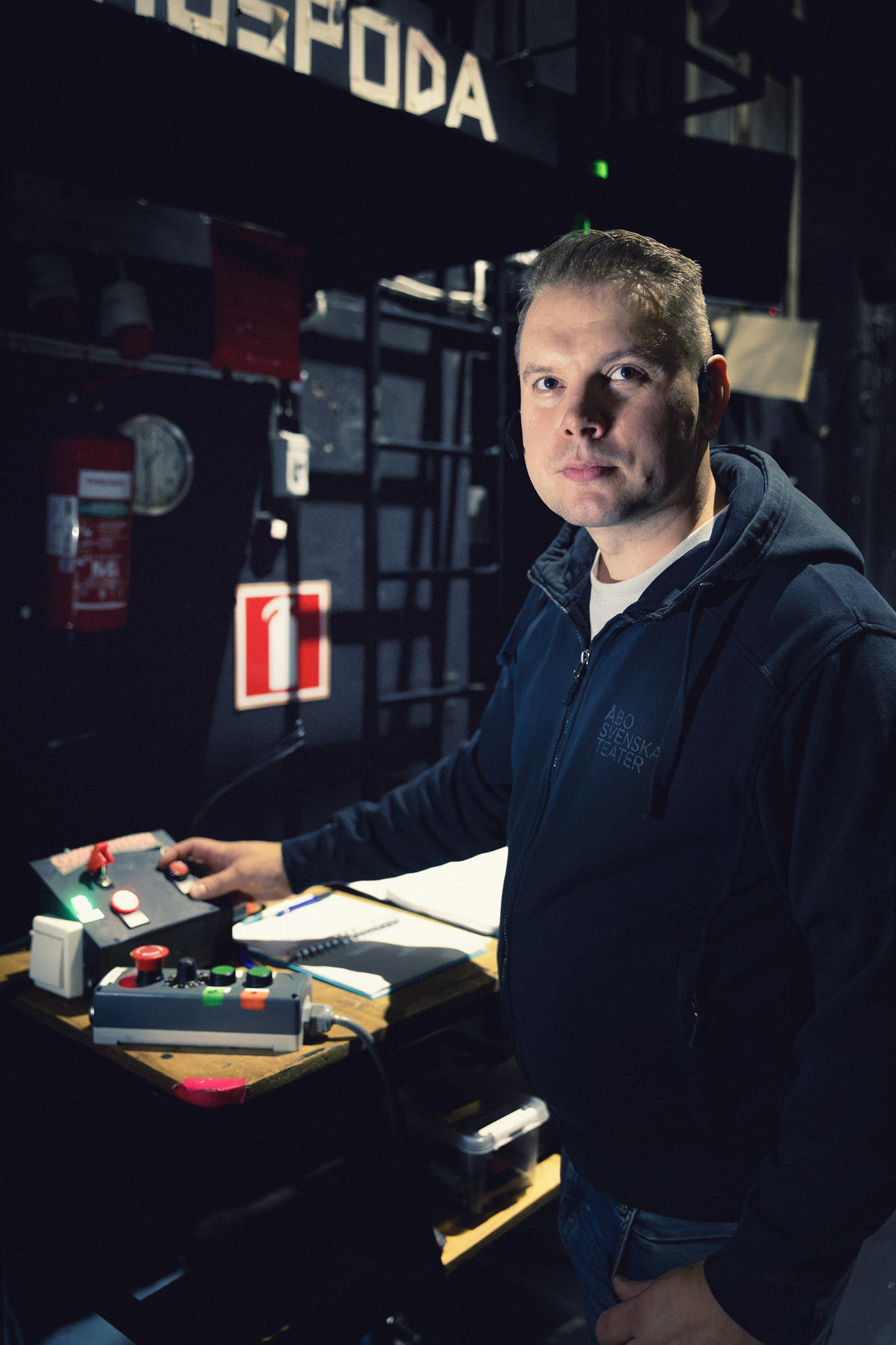
Today, Golnick works as a lighting and sound technician at Åbo Svenska Teater in Turku, Finland. His responsibilities extend well beyond his job title, and the expertise he gained during his Master’s studies has already proved valuable. For example, as the theatre prepares for a major renovation of its historic building, completed in 1839, Golnick has been entrusted with coordinating the move to temporary premises.
Returning to Studies After More Than Ten Years in Working Life
Golnick completed his first higher education degree in 2012. By the time he began his Master’s studies in Theatre and Live Event Technology at Metropolia in January 2024, he had accumulated more than ten years of professional experience. He graduated in spring 2025.
His decision to return to higher education was primarily motivated by future career opportunities.
“The main reason I decided to apply was to keep the possibility of career advancement open for the future. My employer was also very supportive of the idea,” Golnick explains.
Looking back, he feels the timing was right.
“I already had more than a decade of work experience behind me. During that time, I had seen how the industry operates and learned its professional practices, but there was still plenty more to discover.”
Golnick does not believe that everyone needs as much professional experience before starting a Master’s degree, although he sees it as an advantage. What matters most is having enough practical experience to build on during the studies.
To be eligible for a Master’s degree at a Finnish university of applied sciences, applicants must have at least two years of relevant work experience after completing their previous higher education degree.
From Practical Skills to Broader Professional Expertise
According to Golnick, previous work experience is what makes Master’s studies different from studying for a first higher education degree. Students are not starting from scratch. Instead, everyone brings their own professional knowledge and experience into the classroom.
In Theatre and Live Event Technology, this means that students are already familiar with the technical fundamentals of their profession. The studies therefore focus on exploring broader questions, such as professional responsibilities, legislation and occupational safety.
“We were no longer learning how to rig a theatre light safely, for example. Instead, we focused on who is responsible for what, what occupational safety legislation requires and what needs to be considered. In a way, the studies take your thinking to the next level,” Golnick explains.
This broader expertise is particularly valuable in positions involving greater responsibility.
Golnick recommends the Master’s degree in Theatre and Live Event Technology to professionals who see themselves moving into demanding roles at cultural institutions or event technology companies, especially positions involving planning, management or safety responsibilities.
At festivals, for example, professionals need to understand safety from several perspectives, taking into account employees, performers and audiences alike.
Learning from Other Professionals Was One of the Greatest Benefits
One of the most valuable aspects of the programme, according to Golnick, was the study group itself and the strong sense of support among students.
His fellow students included professionals working in theatres, museums and event technology organisations across Finland.
“It was incredibly enriching. Networking with professionals from different areas of the performing arts was one of the greatest benefits of the programme. I now have valuable contacts all over Finland,” Golnick says.
The diverse group offered much more than networking opportunities. Because students came from different professional backgrounds, they approached familiar challenges from new perspectives.
For example, discussions might explore how practices used in the event industry could be applied in theatres, or how theatre professionals could contribute ideas to event production.
“Everyone already had their own knowledge and work experience. That brought a wide range of perspectives into the classroom and really broadened my own thinking.”
Students’ professional experiences also became a practical part of the programme through study visits. In addition to teaching at Metropolia’s Arabia Campus in Helsinki, contact teaching sessions were organised at students’ workplaces.
The group visited venues including Logomo and Åbo Svenska Teater in Turku, Sibelius Hall and Lahti City Theatre in Lahti, and Helsinki Music Centre.
“We had the opportunity to see how the industry operates in different organisations and environments,” Golnick says appreciatively.
Combining Work and Master’s Studies Was Manageable
Golnick completed his degree alongside full-time work in approximately one and a half years.
The programme was delivered mainly online, with in-person teaching sessions held approximately once a month. These sessions were designed to make efficient use of students’ time, often covering several course topics during the same day.
In Golnick’s case, combining work and studies was made easier by his employer’s strong support. He was also able to use some of his working hours for studying.
However, he points out that such arrangements depend on the employer and the nature of the job.
Students in his group had different work commitments and personal circumstances, but they were able to fit their studies around their individual situations.
“It is worth setting aside the recommended amount of time for studying in your calendar. It is also important to think about what you personally want to achieve through the degree,” Golnick advises.
A Master’s Thesis That Explored a Real Challenge in Working Life
The Master’s thesis is a significant part of the degree, accounting for half of its total scope.
Golnick found his thesis topic close to his own professional environment. He examined a specific additional allowance under the theatre sector’s collective agreement and how it applies to different theatres.
The idea first emerged early in his studies during a conversation with the administrative director at his workplace.
Although he considered other topics, he eventually decided to investigate the issue through collective agreements, their historical development, legislation, interviews and comparative analysis.
The result was a 99-page thesis.
His findings and background research have also been shared with industry unions, and Golnick hopes the work will offer new perspectives for future collective bargaining negotiations.
However, from a professional development perspective, the most valuable outcome was not necessarily any single research finding.
“I feel I gained the most from the process itself. Researching information and examining legal provisions and the history of legislation really developed my expertise. When you move into more demanding roles with managerial or supervisory responsibilities, legislation and collective agreements become extremely important.”
Golnick also appreciated the support available throughout the thesis process.
His supervising lecturer was there to help whenever needed, and the programme included structured peer support and opportunities to provide feedback on fellow students’ theses.
“It Was Exactly the Right Time for Me to Study”
Golnick’s study group included professionals of different ages, from those under 30 to people approaching retirement.
According to him, differences in age or professional background did not divide the group. Quite the opposite: the programme made use of this diversity, deliberately bringing students with different experiences together for group assignments.
Looking back on his own career, Golnick feels he chose exactly the right moment to pursue his Master’s degree.
He had enough professional experience to connect what he was learning to real situations at work, while still being eager to develop his knowledge and skills.
His advice to anyone considering the programme is practical: make time for studying and approach the experience with an open mind.
He particularly recommends starting to think about a possible thesis topic early on and defining its scope carefully.
Golnick’s own career journey, from dreaming of becoming an actor to working as a theatre technology professional, is also a reminder that career paths do not always follow a straight line.
For experienced professionals, Master’s studies can offer an opportunity to reflect on their expertise, discover new perspectives on a familiar industry and develop the skills needed for the next stage of their careers.
Why Study for a Master’s Degree in Theatre and Live Event Technology at Metropolia?
Are you looking to deepen your expertise in theatre, performance or live event technology?
Metropolia’s 60 ECTS Master’s degree programme offers qualified professionals in theatre, performance and event technology the opportunity to strengthen their expertise, particularly in leadership, supervisory roles and development work.
Graduates gain the advanced competencies needed for demanding roles that combine technical and artistic responsibilities. The programme will be offered in English for the first time, with the first students starting their studies in autumn 2027. Applications can be submitted during the January joint application period.
Explore the Master’s Degree in Theatre and Live Event Technology at Metropolia