3D Game Art, Bachelor's Degree
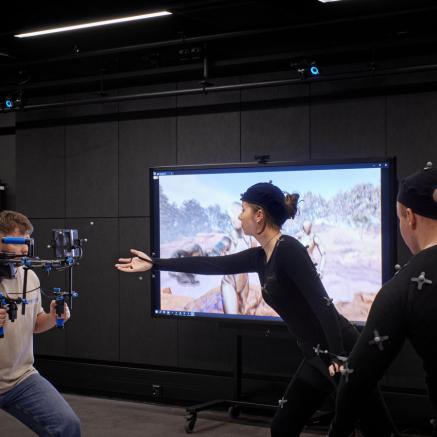
As a student of 3D Game Art, you will learn to use 3D graphics to produce images, animations, special effects, and real-time 3D applications for both traditional devices and VR/AR/XR devices
As a student of 3D Game Art, you will learn to use 3D graphics to produce images, animations, special effects, and real-time 3D applications for both traditional devices and VR/AR/XR devices
3D Game Art has a long history as an extremely popular and successful degree programme in Finnish. Now for the first time this programme is available also in English!
If you're interested in 3D studies, there will be two application opportunities in spring 2027. The English-language 3D Game Art programme will be available in the first joint application round in January, while the Finnish-language 3D Animation and Visualisation programme will be offered in the second joint application round in March. As the programmes share the same core content, applicants who are comfortable studying in English are encouraged to apply to both.
Those interested in the gaming industry may also want to consider the English-language Game Design programme, which is available in the first joint application round.
Games made by our students:
A 3D Game Art student is required to have three-dimensional visualization skills, the ability to communicate using images, and motivation to learn new tools. Knowledge of 3D programs is not required of the applicant - they will be studied in depth during the education.
In addition to 3D courses, the degree also includes study modules in the areas of 2D motion graphics and animation, as well as traditional visual arts and visual design
3D productions are usually created as a collaboration between specialists from several different areas. During the studies, students often work in production groups that simulate work life practices. This intensive working model requires students to commit to full-time studies.
During their studies, 3D Game Art students work on large projects in which they get to know and delve deeper into the special areas of 3D production. In the final stage of their studies, projects are often done in collaboration with representatives of work life.
3D graphics expertise is in demand across games and simulators, film and television, advertising, VR/AR/XR experiences, visual effects, architectural and product visualization, scientific visualization, and interactive digital applications such as user interfaces and instructional content.
Graduates work in roles such as game artist, character designer, animator, VR/XR artist, compositor, VFX artist, advertising graphic artist, architectural visualizer, product visualizer, and TV graphics designer. Employment opportunities can be found in the gaming and entertainment industries, TV and film production, advertising and design agencies, educational content production, and research and science visualization.
Annual tuition fee for non-EU/EEA applicants 12 000 €.
This fee applies only to non-EU/EEA degree students.
The Design degree programme offers the following studies:
Game & XR Creator - Immersive Media Start, 7 cr
Enroll through the Metropolia's Open UAS
For more information about studying at the Metropolia's Open UAS
You will receive information 1–3 times a year about Metropolia's degree programmes, application schedules, and studying with us.
In the spring 2027 Joint Application 1 to higher education, you can apply to degree programmes that start in the autumn of 2027. The application period starts on the 7 January 2027 at 8 am and ends on the 21 January 2027 at 3 pm (local time in Finland).
All the information needed to apply can be found on the national Studyinfo.fi portal. At Studyinfo.fi you can find descriptions of degree programmes, application criteria, application instructions, application forms and much more.
Applicants who are not citizens of the EU, EEA or Switzerland are required to pay an application fee in order to apply to higher education studies. The application fee of 100 euros is collected for applicants from countries outside EU/EEA seeking education leading to a degree in higher education. The Finnish National Agency of Education will collect the application fee in connection with filling in the Studyinfo application form. There is no application fee for Finnish or EU citizens.
The application fee does not guarantee that you will be offered admission to studies. The application fee is not refunded if you cancel your application or are not offered admission.
More about application fee in Studyinfo.fi.
Questions about application fees? Contact applicationfee [at] oph.fi (applicationfee[at]oph[dot]fi)
The One Study Right Rule refers to legislative amendments entered into force on 1 August 2026. Under these amendments, a student’s study rights at the same or lower level will be terminated if they accept a new study right leading to a degree. The rule applies only to study rights at Finnish higher education institutions.
Create a design for a game character and an accompanying prop. Base the character's visual design on your own appearance, and the prop's design on an everyday object.
The visual style of the character and prop can be photorealistic, stylized, or anything in between - you decide. Aim to create an interesting and unique design for both, while retaining key visual elements from their inspiration sources: yourself and the chosen everyday object.
Create three images describing your creative process:
A photo of yourself holding the everyday object of your choice. The photo can be taken by someone else, or it can be a selfie - if you manage to hold the object and your phone simultaneously.
A sketch of the game character holding the game prop. This can be a photo of the sketch or a screenshot of the software you are using in the early phases of your design process.
A finished image of the game character holding the game prop. This image should clearly show what the character and prop look like, including lighting, shadows, and colors.
Use a camera or phone to create Image 1. To create Images 2 and 3, you can use any non-AI tools: draw or paint on paper, use digital painting software, or use 3D modeling tools. Do not generate any of the images using AI. If you work on paper, photograph or scan your work. Keep all paper sketches and working files — Metropolia may ask to see them later in the selection process. Do not edit your files after you have created and sent your final pdf to Metropolia.
Create a single PDF file containing all three images. You may choose the layout and relative size of the images freely. The PDF can be between 1 and 3 pages long - you can place all images on a single page or each image on its own page. The maximum file size must not exceed 20 MB.
Name the PDF file as follows: Surname_Firstname_3D_2027_1.pdf
Assessment criteria: Fluency of visual storytelling, design and personality of the character and the prop, three-dimensional representation of the character and the prop, mastery of the chosen visual medium.
Create a portfolio showcasing your visual work. Select up to three previous projects, including both final results and work-in-progress materials, such as sketches.
Select projects that show how you work with concepts related to 3D art: three-dimensional shapes, light and shadow, colors and textures, or the design of characters, assets or environments. The images showcasing your work can be created using any non-AI tools: drawing or painting on paper, digital painting software, or 3D modeling tools. Do not generate any of the images using AI.
Create a single PDF file containing all portfolio projects, placing each project on its own page. You may add short captions to describe each project. The PDF should be between 1 and 3 pages long, depending on the number of projects included. The maximum file size must not exceed 20 MB.
Name the PDF file as follows: Surname_Firstname_3D_2027_2.pdf
Assessment criteria: Fluency of visual storytelling, design and personality of the projects, three-dimensional representation, mastery of the chosen visual media.
3D Game Art reserves the right to request additional information and, if necessary, invite applicants to demonstrate their skills in an online live session.
In order to be considered for the student selection, you must fill in the joint application form at Studyinfo.fi during the application period 7 January - 21 January 2027. The pre-assignment must be submitted as an attachment to the electronic joint application form during the application period, by 21 January 2027 3:00 p.m. the latest (local time in Finland).
Pre-assignments for spring 2027 Joint Application 1 will be published by the beginning of the application period.
In order to be considered for student selection, you must pass the degree programme's own entrance examination as described in Studyinfo.fi. Entrance exam invitations are sent approximately one week before the entrance exam by email to the email address provided by the applicant on the application form.
Next spring, there will be two 3D programs available: Finnish-language 3D Animation and Visualization in the second joint application round of spring 2027, and English-language 3D Game Art in the first joint application round of spring 2027. The content of these programs is the same, so if studying in English isn’t a problem for you, you should definitely apply to both. In addition to these, for those interested in the gaming industry, an English-language program in Game Design will also be available in the first joint application round in spring 2027.
The first joint application round for spring 2027 begins as early as January, and the second round in March. So if you’re applying next spring, be sure to follow the application instructions carefully and well in advance!
Tel. +358 9 7424 5902, Mon-Wed 10 am – 12 pm

First, read guidelines common to all Metropolia degree students and then degree specific instruction below.
Next spring, there will be two 3D programs available: Finnish-language 3D Animation and Visualization in the second joint application round of spring 2027, and English-language 3D Game Art in the first joint application round of spring 2027. The content of these programs is the same, so if studying in English isn’t a problem for you, you should definitely apply to both. In addition to these, for those interested in the gaming industry, an English-language program in Game Design will also be available in the first joint application round in spring 2027.
The first joint application round for spring 2027 begins as early as January, and the second round in March. So if you’re applying next spring, be sure to follow the application instructions carefully and well in advance!