Established 3D degree programme to launch in English in 2027 – Metropolia educates future 3D professionals at the heart of Helsinki’s game industry ecosystem
Metropolia’s long-running 3D Animation and Visualisation programme will be joined by a new English-language degree programme in 3D Game Art. The new programme will prepare expertise that has been developed at Metropolia for decades accessible to international students. The studies emphasise hands-on learning, long-term production projects and working in a studio-like environment.
Metropolia’s new English-language 3D Game Art degree programme is built on a strong foundation. It draws extensively on the Finnish-language 3D Animation and Visualisation degree programme, which has been offered since 2001.
Markus Norrena, Head of the new degree programme, and Jaro Lehtonen, Senior Lecturer, explain that the new English-language programme is largely based on the same content, while giving the game industry a more prominent role than before.
“This highly sought-after and popular 3D degree programme will now also be offered in English, making the studies accessible to an even wider group of students. We have a long tradition and extensive experience in providing this education,” Lehtonen says.
The Finnish-language programme has consistently attracted a high number of applicants. According to Lehtonen, in the second joint application round of spring 2026, the programme ranked as the second most sought-after higher education degree programme in the field of culture.
The English-language programme will admit 20 students per year, the same number as the Finnish-language programme. Starting in autumn 2027, the programme comprises 240 ECTS credits and takes approximately four years to complete. Applications for the programme will open in the January 2027 joint application.
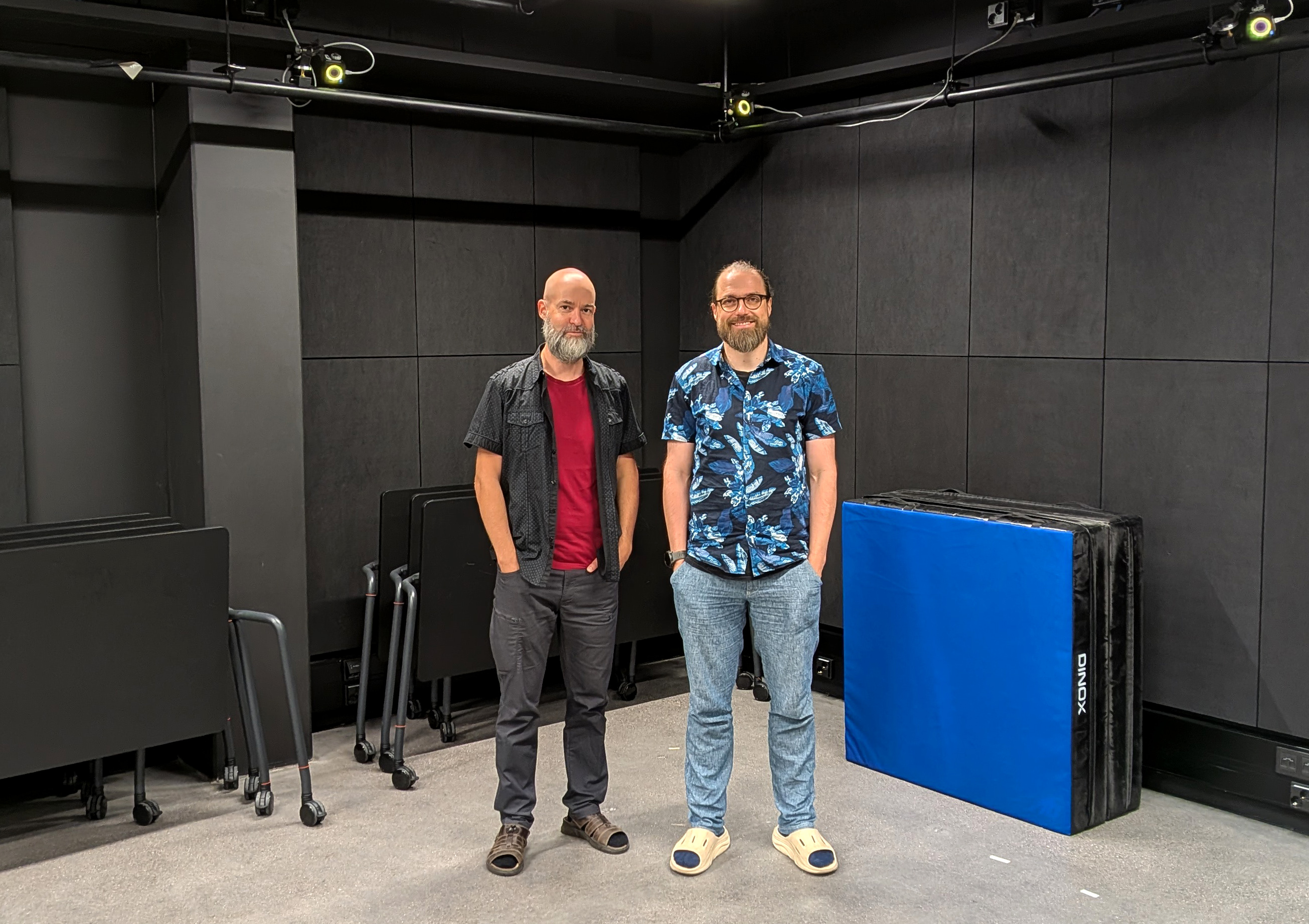
Jaro Lehtonen and Markus Norrena in the mocap studio at Metropolia’s Arabia Campus.
Learning 3D by doing
In 3D Game Art, students’ everyday studies do not primarily revolve around theory and textbooks. Norrena explains that much of the learning takes place through hands-on work at the computer.
“You need to be interested in storytelling and technology to work in this field. Studying and working in 3D involves a great deal of computer-based work and is particularly hands-on.”
The studies begin with the fundamentals, but students move on to different types of productions at an early stage, simulating the everyday work of the game industry. Students may first work on animations and short films, for example, and later progress to complete game projects. Long-term project courses form the core of the curriculum.
“The idea is to replicate the working methods used by professionals and companies in the industry. Students work on real, long-term projects, often in teams, and go through the same stages of production as they would in a game company or animation studio, for example,” Lehtonen explains.
Theory also has its place, but it is integrated into practical work. Norrena and Lehtonen explain that the technical fundamentals of 3D graphics, for example, are covered as part of project courses and practical exercises.
“We go through the topics in class, and then students put them into practice and apply what they have learned themselves. Compared with many other fields, there is relatively little written work. The emphasis is strongly on 3D production itself and developing practical skills.”
Turning the classroom into a studio
The studies take place mainly at Metropolia’s Arabia Campus in Helsinki. The degree programme’s skilled and experienced lecturers have decades of experience in teaching 3D graphics for the game industry and are eager to share their expertise with a new generation of professionals. The strong emphasis on in-person learning is a deliberate choice: the aim is to recreate the collaborative way in which industry professionals work together in studios.
In the computer labs, each student has access to a workstation and all the software required for their studies. Having your own computer is useful in practice, but all the equipment and software needed during classes are available on campus.
“We do a lot of studio-style work where students are physically present in the same space. When you can see what another student is working on, for example, it is easy to ask questions, discuss ideas and solve problems together. This also makes learning more effective,” Lehtonen emphasises.
At the same time, students develop one of the key skills needed in the game industry. Working as part of a multidisciplinary production team is an essential part of professional game development.
Creating a game takes many different professionals
A game education cluster is taking shape at the Arabia Campus, bringing together expertise in game visuals, design and technical development.
Alongside 3D Game Art, a new English-language Game Design degree programme will also begin at the campus in autumn 2027. Collaboration will also extend to engineering students specialising in game programming. Metropolia’s aim is to create a comprehensive game education environment where students from different disciplines can work together to develop games from start to finish.
According to Lehtonen and Norrena, this is particularly important because the game industry encompasses a wide range of professional roles.
Game artists, game designers and programmers each need in-depth expertise in their own field. During their studies, however, students can learn to work together in the same way they would in a professional game production.
Collaboration between different degree programmes and international students has a long tradition at Metropolia. For example, in the third-year game project of the Finnish-language 3D programme, 3D artists work on joint projects with game programming students and exchange students, among others. The working language of the course is English. In the future, the course will also provide a natural meeting point for students in the Finnish- and English-language 3D Game Art programmes.
Game industry workplaces have traditionally been highly international and multicultural, with English commonly used as the working language.
Connecting with the industry during your studies
At Metropolia, connections with game industry companies are an integral part of the studies. Metropolia alumni regularly visit the programme to share their career experiences, including their work at game companies. During the third year, students compile their work into a showreel, which is reviewed by industry professionals. Students receive valuable feedback while also beginning to prepare for applying for internships.
Another long-standing practice is working on commissions from external clients in the game and creative industries. In previous years, students have produced animation projects for television, educational materials and animation festivals, for example. This close collaboration between students and working life will continue in the new English-language programme.
The degree also includes approximately five months of internship experience at a company in the game industry, helping students prepare for their future careers. Students are responsible for finding and applying for their own internship positions, but Metropolia supports them through its industry contacts and professional networks.
Helsinki puts you close to the game industry
For international students, the learning environment extends well beyond Metropolia’s Arabia Campus in Helsinki.
The Helsinki metropolitan area is home to hundreds of game companies, many of which have achieved international success. For students, this means that the industry and its professionals are close at hand, both geographically and professionally. Students in the 3D programme regularly visit game studios, including companies where Metropolia alumni now work.
The Arabia Campus is also home to the Helsinki XR Center, which supports startups working in areas including games and extended reality. Students also have opportunities to develop their own business ideas through the startup incubator.
According to Lehtonen, being physically present in this environment makes a real difference.
“Helsinki is a great place to come and study, live and become part of the game industry scene. The campus brings together closely related fields that support your studies, while the Helsinki metropolitan area has many of the industry’s key players concentrated within a relatively small geographical area.”
The new degree programme therefore aims to place students not only at the heart of Metropolia’s 3D expertise, but also within Finland’s internationally connected game industry community.