From Technical Expert to Leadership and Development Roles: A New Master’s Degree Takes Your Expertise in Theatre and Live Event Technology to the Next Level
At what point does an experienced professional need further education? According to Tero Aalto, Senior Lecturer in Charge of the Degree Programme, there is no single answer. Metropolia has offered a similar Finnish-language Master’s programme since 2022, attracting professionals at different stages of their careers – from those with relatively few years of experience to those who have worked in the industry for decades.
However, many students reach a point where they already know their field well and have begun to think about where they want to go next.
“Many have gained enough experience to understand what the industry is really like and realise that they need new skills to take the next step,” Aalto says.
A Master’s degree can become particularly relevant when a technical expert wants to move towards production management, supervisory or leadership roles, or organisational development. In some cases, not having a higher university degree may also limit opportunities for career progression.
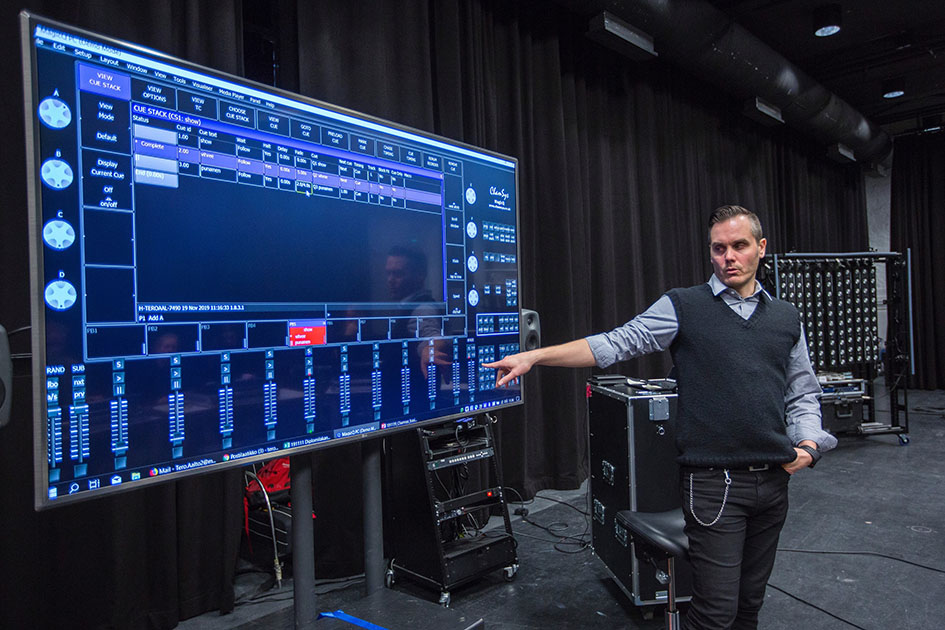
Senior Lecturer in Charge of the Degree Programme,Tero Aalto.
Photo: Studyinfo / Olli Häkämies.
From Expert to Leader – Sometimes Even Before Graduation
According to Aalto, the impact of Master’s studies can become visible in students’ careers even before they graduate. Of the approximately 20 students who began the first Finnish-language programme in 2022, he estimates that six moved into more senior positions during their studies.
“We have even had the positive problem of students’ job titles changing while they are still studying. Many have moved into more demanding roles during their studies, and as a teacher, I am of course proud to see that.”
Students and graduates can work across a wide range of organisations. Potential workplaces include theatres and other performing arts organisations, music and cultural venues, festivals and event productions, as well as companies specialising in technical services and solutions.
Depending on their professional background and experience, graduates may work in roles such as production manager, technical director, head of performance technology, stage manager or in supervisory and leadership positions in lighting, sound and video technology.
Leadership is the common thread running through the expertise developed in the Master’s degree. According to Aalto, learning to lead both people and productions is at the heart of the programme.
Turn Your Own Work into a Learning Environment
The Master’s programme is designed to fit flexibly around professional and personal commitments. It follows a blended learning model with a strong emphasis on remote learning. On-campus or online sessions are planned to take place a few times each month.
Although the format provides flexibility, combining studies with work and other responsibilities still requires planning.
“Studying alongside work requires good time management and sometimes the ability to say no. However, we have designed the programme so that completing the degree alongside work and other commitments is genuinely possible,” Aalto says.
Flexibility does not mean that the studies are disconnected from professional practice – quite the opposite. Students can use their own workplace as a learning environment. During project-based studies, for example, they can examine processes within their own organisation and apply new approaches directly in practice.
According to Aalto, this means that the studies can create tangible benefits for both the student and their employer even before graduation.
Your Master’s Thesis Can Have an Impact Beyond Your Own Career
Half of the 60-credit degree consists of the 30-credit Master’s thesis, and its substantial role in the programme is intentional. According to Aalto, the aim is not simply to complete a thesis in order to graduate, but to address a real challenge or contribute to the development of the industry.
A thesis may focus, for example, on leadership, production process development, occupational safety or performance technology. Many theses completed by students in the existing Finnish-language programme have been practice-oriented development projects carried out in collaboration with organisations in the field.
“We are a small industry, and that is exactly why we want every thesis to be a good one. At its best, a thesis does not only develop the student’s own expertise – it can change the way the entire industry works.”
According to Aalto, this has already happened: theses completed in the corresponding Finnish-language Master’s programme have contributed to changes in professional practices in Finland.
An International Study Group Can Become a Professional Network
One of the aims of the new English-language degree is to bring together professionals from different countries, organisations and production cultures.
This is particularly relevant in theatre and live event technology, where working internationally is already part of the profession. Finnish professionals work on international tours, productions and events, and Aalto points out that English is already commonly used as a working language at many of Finland’s largest festivals.
An international study group also creates opportunities for Finnish production expertise to meet approaches and practices from other countries.
“I hope we will have a genuinely international group. When people bring experience from different productions and cultures, students learn not only from their teachers but, above all, from one another,” Aalto says.
For professionals coming to Finland from abroad, the programme can therefore also provide an opportunity to become part of a network of people working across the Finnish and international theatre and live event industries.
Why Study for a Master’s Degree in Theatre and Live Event Technology at Metropolia?
Aalto highlights efficiency, safety expertise, the use of technology and the broad skill sets of professionals as particular strengths of the Finnish theatre and live event technology sector.
Finnish professionals work internationally, and Finnish expertise in production and leadership is also applied in organisations outside Finland. According to Aalto, Finland is advanced, for example, in the use of digital tools for production planning.
“Finland is a small country, and that is one of the reasons why our expertise is so versatile. We have learned to work efficiently and achieve a great deal with relatively limited resources.”
Metropolia brings Master’s-level education into this professional environment, offering experienced professionals an opportunity to build new competencies on top of an already strong foundation of industry experience.
The Master’s degree can provide new perspectives on your current work and strengthen your capabilities to move from technical expertise towards more demanding leadership and development roles. At the same time, you can contribute not only to the development of your own organisation but also to new ways of working across the industry.
Applications Open in January 2027
Applications to the new Master’s Degree in Theatre and Live Event Technology will open for the first time in the January 2027 joint application.
The 60 ECTS English-language degree is designed for professionals working in theatre, performing arts and live event technology. Applicants are required to have a suitable Bachelor’s degree or other applicable higher education degree and at least two years of relevant work experience.
The programme begins in autumn 2027. Its flexible blended learning format is designed to make it possible to study alongside work, and the degree can be completed in approximately 1–1.5 years.
Explore the Master’s Degree in Theatre and Live Event Technology and find out how to apply