
Finished
NEST project
Empowering sustainable health ecosystems in Europe
NEST Innovation Alliance co-created a new form of social innovation ecosystem for promote residents’ wellbeing.
5th Generation Learning Ecosystems bring together local communities, educational institutions, businesses and citizens to collaborate on real-life challenges.
Read more about learning ecosystems
Ecosystems are not static. People come and go, priorities change and new challenges emerge.
Learn more about tools for supporting ecosystems
Educational institutions are increasingly expected to prepare students to work with complex societal challenges and across disciplinary boundaries. This means creating opportunities for learning beyond classrooms and campuses, where students can engage with real-life challenges together with local communities.
But how can we bring this kind of learning into everyday education, rather than keeping it within individual projects or courses?
Innovation hubs, living labs, community centres and other local environments offer opportunities for this to work together, share knowledge, test ideas and learn from each other. In NEST, we call these collaborative environments learning communities. They are not necessarily built around fixed tasks or predefined outcomes. Instead, people come together around shared interests and challenges, and the activities evolve as they learn and discover new possibilities. It helps students develop skills that are difficult to learn in classrooms alone, such as working with uncertainty, collaborating across sectors and finding solutions together.
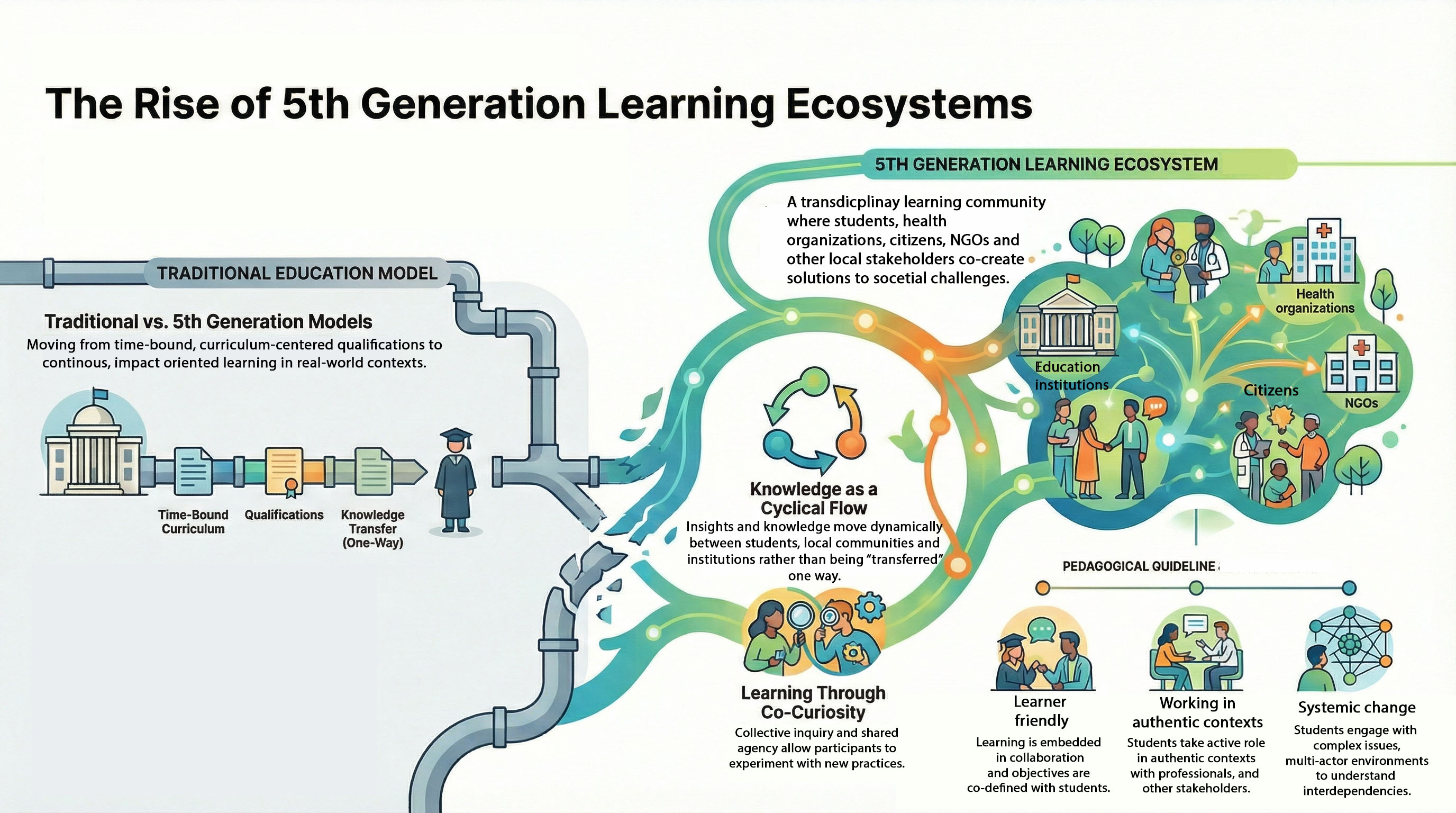
This connects education, RDI and practice and helps make learning part of wider local development. Over time, learning communities can therefore contribute not only to individual learning but also to the capacity of organisations and the wider ecosystem to learn, adapt and create change together.
Whether you're an educator, curriculum designer, educational developer or working in educational management, you'll find practical ideas and guidance to adapt to your own educational and local context.
Are you involved or interested in building, facilitating or developing ecosystems, living labs or other collaborative networks? Looking for practical ways to strengthen collaboration, organise shared governance or support learning and development?
In NEST, we called these and worked with Social Innovation Ecosystems for Healthy Living (SIEHLs) – local communities where citizens, organisations, educational institutions and other stakeholders come together to tackle challenges related to health and wellbeing. Sharing knowledge, learn from each other and develop new solutions together, based on local needs.
But building an ecosystem is not something you do once and then it's ready. People come and go, relationships develop, priorities change and new challenges emerge. Instead of asking whether our ecosystem is ready, we should focus on how we can keep learning, adapting and preparing for what comes next.
Whether you're just getting started or already working in an ecosystem, living lab or collaborative network, you'll find ideas and practical support that you can adapt to your own needs. The NEST Learning Platform brings together practical guides, tools and online learning to help you strengthen collaboration, facilitate change and turn ideas into action in your own community.
Healthy living is of high priority on the EU agenda. Yet, it is a complex challenge that requires to break up the fragmented health sector. The NEST Innovation Alliance co-created a new form of social innovation ecosystem that acts as a sustainable vehicle for societal transitions and increased capacity in knowledge creation towards healthy living.
Alliances will be anchored in strategic and sustainable cooperation among vocational education and training (VET), higher education (HE) and enterprises working together to boost the innovation capacity of Europe. They will considerably strengthen the synergies between both educational fields in fostering innovation, new skills, a sense of initiative and entrepreneurial mind-sets. The Alliances for Innovation will focus on the need of citizens and accelerate the modernization of HE and VET.
The Alliances will help to implement the EU Communication on the Renewed Agenda for Higher Education and contribute to the creation of a European Education Area. The Alliances for Innovation will also take into account the Agenda 2030 Sustainable Development Goals.
How to position and organise a social innovation ecosystem sustainably into long term societal transitions? And how to grow and maintain knowledge and collective agency of the diverse healthy living stakeholders in social innovation ecosystems? To answer these questions, we implement four international communities of practice on
Social business development
Engaged community science
Reflexive monitoring
Knowledge creation
To measure our objectives, we used a mix of SMART and Learning-Oriented Indicators. It means that we worked
result-oriented to fullfil our EU funding requirements, but learning-oriented when it comes to our content development.
Ten project partners from six countries plus one European network partner from higher education, VET, research, and businesses.
NEST-project was implemented in years 2023-2026 and was co-funded by European Union.
Visit NEST-project website to learn more!

